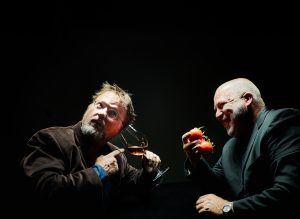

Award-winning wine and food writers Richard Cornish and Max Allen; aka – The Hungry Gentlemen – hit the road to present The True Story of Oysters and Champagne and Stanley Pub on 22nd August.
They’ll share tales about ancient native oyster reefs around Victoria’s shoreline and wash it all down with French champagne -suitably iced for their decadent afternoon of banter, history lessons and good times.
A glass of Gosset and an oyster shooter on arrival by the fire.
Richard Cornish talks to the Write Drop for our At The Bar series.
MY CITY
We used to live in the quiet regularity of the suburbs but moved to St Kilda three years ago. Now we are woken by addicts screaming at their demons in the middle of the night, and there are sex workers in the back lane. I now know most of their names, where they come from and why they do what they do. And for the first time since I moved from the country as a kid, I know almost all my neighbours. We cook for each other when we are ill, we dine together when we have plenty, and we play music well into the night. We left the certainty of the suburbs for the reality of a mixed community. We feel at home and have never been happier.
FAVOURITE FOOD MEMORY
There is a restaurant in Getaria, in Spain’s Basque Country, named Elkano after the navigator who took command of Magellan’s expedition after Magellan was killed in the Philippines. The Basques have a long maritime tradition, whether it be the baleneros — whalers — who hunted in the Atlantic, or the coastal fishermen whose oilskins inspired a young local boy from the Balenciaga family later in life.
Elkano specialises in fish cooked over charcoal in the laneway outside the restaurant. The chefs baste whole turbot with salt water in which offcuts of jamón have been soaked, along with a little citrus and oil. This seasons the fish as it cooks in wire cages. At the table, the camarero — maître d’ — takes you on a tour of the muscles of the fish, each group with its own flavour and texture. The muscles beneath the dorsal spine are gelatinous and packed with briny umami, while the softer muscles on the underside are rich, luscious and almost creamy. Together with a glass of Txakoli grown and made at the end of the road, and a view over the Urola Coast, it is unforgettable.
FAVOURITE BAR
I like public bars. I like bars where the owner, their family or their mates serve you a beer. I like the anonymity of the public bar in a country town or an interstate suburban pub. I like the utilitarian nature of the place combined with individuality. If they have held onto the wooden door on the beer fridge, so much the better. If there is an oddly stuffed animal on the wall, I’ll like that. If there is a collection of similar objects, such as old wine bottles that once held exceptional wines or pressed tin toys from the 1950s, that’s reassuring. I’ll order whatever bitter or dark beer they have on tap or in a bottle.
DRINK THAT DESCRIBES YOU
Stout.
BEST HANGOVER CURE
Vigorous sexual activity when I was a younger man but, more recently, the cold waters of Port Phillip have proved remarkably bracing, especially in winter. I swim several times a week.
BEST INTERSTATE BAR
There are several.
Lake Eacham Hotel, Far North Queensland — There is a cast-iron, wood-fired range in the kitchen the size and weight of a Kia, on which they cook everything, including roast lamb. It’s the perfect place after swimming in the bottomless volcanic crater lake, filled with crystal-clear water and inhabited by freshwater turtles.
Dinah Beach Yacht Club, Darwin — I order whatever is being cooked by the recovering alcoholic chef in the donga and an ice-cold Coopers, which I drink on the finger wharf jutting into Darwin Harbour, surrounded by sly crocodiles.
Essa, Brisbane — I dine at the bar at this Fortitude Valley restaurant and always enjoy its selection of wines by the glass. They champion small producers, with a focus on quality wines from biodynamic vineyards.
FAVOURITE WINE
I would like to say that I recently had a flinty Sancerre or a creamy Meursault. But I grew up on the Mornington Peninsula and turned 18 in 1985. That was about the same time Mornington Peninsula chardonnay was coming into its own, so I grew up with those big, blousy chardonnays — all vanilla and cedar from French oak, stone fruit from the Chardonnay clones that were planted back then, and buttery richness from malolactic fermentation.
It’s a much-maligned style these days, but it is the wine that formed a huge part of my upbringing. Surprisingly, it goes remarkably well with strongly flavoured lamb. There is something about the lanolin notes in the lamb that works beautifully with the oak and the malo.
Those styles of wine are not made anymore — and for good reason. But a young winemaker called Owen Latta makes a Chardonnay with grapes from a vineyard at Tarrington. It undergoes malo and then spends time in oak. His 2024 Jurassique Blanc Ouillé Chardonnay is super-textured, has extended lees contact and great natural acidity, with salty notes. It is so grown-up compared with those flabby wines I grew up with — I love it.
FAVOURITE WINERY
There are many, but one I return to year after year is Pennyweight in Beechworth. Elizabeth Morris always gives me a hug and tells me off for not marrying my partner of 35 years. She sent us presents when the kids were born.
I love their winery, hewn from raw timber and nestled in the bush like something from a Tom Roberts painting. Her husband, Stephen, takes me through the solera that ages quietly beneath the corrugated iron roof. He blends those old wines with newer ones to make his fortifieds. Their fino is the most Spanish-like wine I have tasted outside Sanlúcar de Barrameda or Jerez.
There is a rumour that his grandfather soaked a handkerchief in a barrel of sherry in Spain, absorbing the flor, which then inoculated the Morris family’s fortified wines. I like to think the autochthonous yeasts of the bush are protecting those wines from oxidation as they age.
To tell you the truth, it is not the winery that I love. It is the Morris family. And now their son Stephen has taken over the reins, sharing his parents’ love of the bush, life in the vineyard and the traditions from which their family comes.
NEXT DESTINATION
Tasmania calls. I have been reading a great deal about Tasmanian history, especially First Nations history, and there are places I want to explore. There is a darkness in Tasmania that is offset by its extraordinary light, and by the independent and creative way people approach problems and view the world.
I want to eat my body weight in seafood and visit my cheesemaking friends to eat their cheese. There is also a fascinating history in Launceston and Hobart of oyster waifs and sex workers that mirrors Melbourne’s and the Victorian goldfields’ rich history of oysters and champagne.
Richard and Max Allen share the Story of Oysters and Champagne at Stanley Pub, Aug 22 at 4pm.